📋 Article Overview
How Bad Is the Loneliness Epidemic in 2026?
The numbers are difficult to read. The World Health Organization now classifies loneliness as a global health crisis. 1 in 6 people worldwide experience persistent loneliness — not just the occasional feeling of being alone, but a chronic, ongoing state that affects mental and physical health.
In the United States, more than 40% of adults over 45 report feeling lonely on a regular basis. Among young adults aged 18–24 — the generation that grew up most connected online — the rates are even higher. The generation with the most digital connections reports the most loneliness. That paradox is one of the defining contradictions of 2026.
📊 Loneliness in 2026 — The Numbers
- 1 in 6 people worldwide experience persistent loneliness (WHO 2026)
- 40%+ of US adults over 45 feel lonely regularly
- Young adults aged 18–24 report the highest loneliness rates of any age group
- Loneliness increases mortality risk by 26% — equivalent to smoking 15 cigarettes a day
- 48% of US teens say social media has a mostly negative effect on their wellbeing
Why Is Everyone So Lonely Right Now?
Several forces are converging in 2026 to make loneliness worse than it has been in living memory:
Social media replaced real connection without replicating it
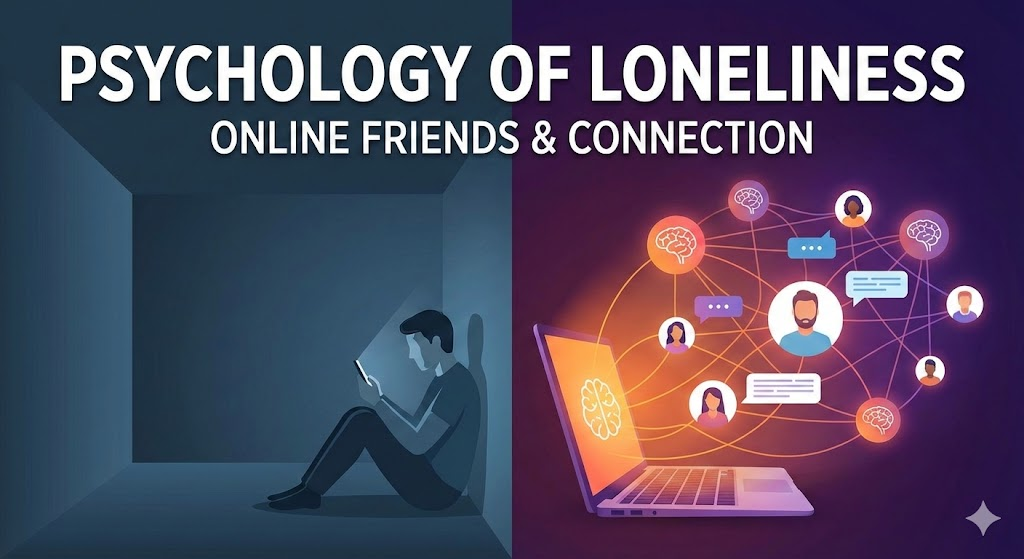
Scrolling someone's feed, liking posts, and watching stories creates the feeling of social contact without the actual nourishment of genuine conversation. We get the dopamine hit of social acknowledgment without any real human exchange. Over time, this trains the brain to feel connected while actually becoming more isolated.
Remote work removed accidental social contact
Before remote work, offices provided a baseline of daily human interaction — hallway conversations, lunch breaks, small talk between meetings. None of it was profound, but all of it mattered. Millions of people lost that without replacing it with anything.
Third places are disappearing
Sociologists call cafés, parks, libraries, and community centers "third places" — spaces that are neither home nor work where people gather informally. These are closing faster than they are being built. Without them, spontaneous human connection becomes harder to find.
More options have made genuine choice harder
Dating apps, social networks, and messaging platforms give the impression of unlimited social choice. But unlimited options can paradoxically reduce connection — when everything is available, nothing feels worth committing to.
What Science Says About Feeling Less Alone
The research on loneliness is clear about what actually helps — and much of it contradicts intuition:
- Quantity matters less than quality — one meaningful conversation does more for loneliness than ten superficial ones
- Vulnerability is the mechanism — sharing something real with another person, and having them receive it well, is the direct antidote to loneliness
- Consistency beats intensity — regular, low-key social contact is more effective than occasional big social events
- Feeling understood matters more than feeling liked — being genuinely heard is what reduces loneliness, not being popular
- Any real conversation counts — research shows even conversations with strangers measurably reduce loneliness
Practical Steps to Fight Loneliness Today
1. Have one real conversation every day
Not a text exchange. Not a like or a comment. An actual back-and-forth conversation where you say something honest and someone responds to it. This can be with a friend, a family member, a colleague, or a stranger. The research shows the quality and honesty of the exchange matters far more than who it is with.
2. Reduce passive social media use
Scrolling is not connecting. It creates the illusion of social contact while deepening isolation. Replace 20 minutes of scrolling with one conversation — any conversation — and the effect on how you feel at the end of the day will be measurable.
3. Be the one who initiates
Lonely people often wait to be invited, reached out to, or noticed. Research consistently shows that people who initiate contact — even imperfectly, even awkwardly — feel less lonely than those who wait. The asymmetry is striking: initiating contact is uncomfortable for about 30 seconds and then either goes somewhere or doesn't, while waiting can last indefinitely.
4. Say something real
The conversations that actually reduce loneliness are the ones where you say something true about how you feel or what you think — not just what you did or what happened. "I've been feeling really disconnected lately" is the kind of honesty that creates connection. "Not much, you?" does not.
Can Online Conversation Help?
Yes — with an important caveat. Passive online activity (scrolling, watching, liking) makes loneliness worse. Active conversation — actually talking to another person online — can genuinely help.
Anonymous chat platforms like Chatrio create conditions for unusually honest conversation. Without the social performance of identity and reputation, people say things they would not say to people they know. That honesty is exactly what the research says reduces loneliness.
This is not a replacement for offline relationships. But it is a genuine and accessible way to have real human contact when you need it — at 2am, on a bad day, in a moment when you just need someone to talk to.
💡 Try It Right Now
If you are feeling isolated, one of the simplest things you can do is open Chatrio and start a conversation with a real stranger. No account, no sign-up, no performance. Just talk. It takes less than 10 seconds to start.
Frequently Asked Questions
Is loneliness really a health crisis in 2026?
Yes. The WHO declared loneliness a global health priority in 2025. Research shows chronic loneliness increases mortality risk by 26% — comparable to smoking 15 cigarettes a day. It is associated with depression, anxiety, cognitive decline, and reduced immune function.
Why are young people the loneliest generation?
Despite being the most digitally connected generation, Gen Z reports the highest loneliness rates. The reason appears to be that social media provides the appearance of connection without its substance — passive scrolling feels social but doesn't actually nourish the social brain the way genuine conversation does.
Can talking to strangers online help with loneliness?
Research says yes — even brief, anonymous conversations with strangers measurably reduce loneliness. The key is that the conversation must be genuine and two-way, not passive content consumption. Platforms like Chatrio facilitate exactly this kind of conversation.
What is the fastest way to feel less lonely?
Have one honest conversation. Not a scroll, not a like — a real exchange where you say something true and someone responds. Research consistently shows this is the most direct intervention available. It can happen with a friend, family member, or a complete stranger.
How do I start a conversation when I feel lonely?
The simplest entry point is anonymous chat — no social stakes, no reputation to manage, just two people talking. On Chatrio you can start a conversation in under 10 seconds without an account. Use the interest matching to find someone who cares about the same things you do.