📋 Article Overview
Introduction: Loneliness in a Connected World
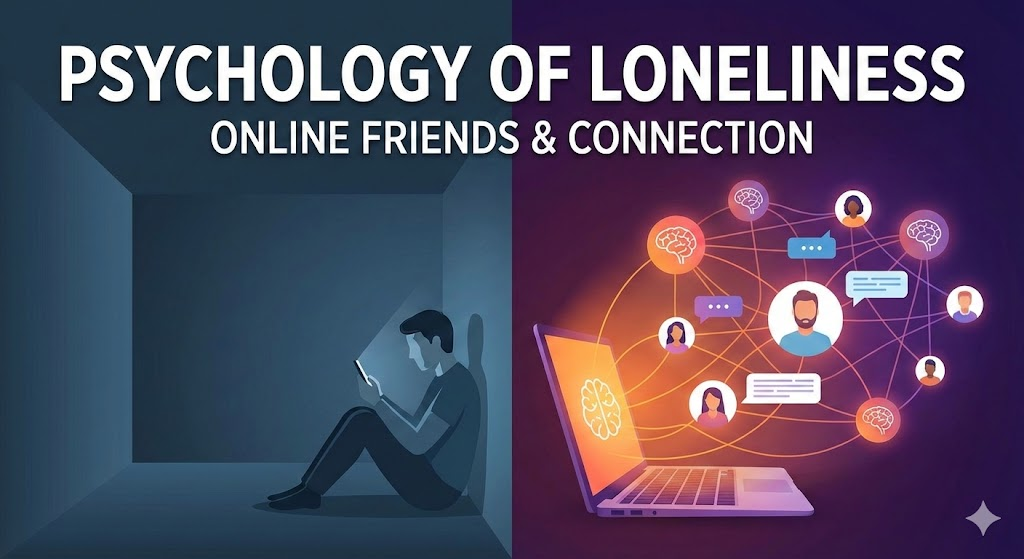
Despite living in the most digitally connected era in human history, loneliness has reached epidemic proportions. According to a 2023 CDC report, more than 1 in 3 adults in the United States report feeling lonely frequently. This paradox of connectivity—being surrounded by people yet feeling alone—has led millions to seek friendships online.
This article explores the psychological underpinnings of loneliness and examines why online friendships, particularly those formed through anonymous chat platforms, have become a significant source of connection for many people.
📊 Loneliness Statistics (2024)
- 58% of Americans report feeling lonely (Cigna Loneliness Index)
- Gen Z (18-22) reports the highest loneliness levels
- 46% of people feel their relationships aren't meaningful (APA)
- Loneliness increases mortality risk by 26% (Harvard Study)
3 Fundamental Psychological Needs Online Friendships Meet
1. The Need for Self-Disclosure Without Judgment
Psychological research consistently shows that self-disclosure—sharing personal thoughts and feelings—is crucial for emotional well-being. A study in the Journal of Personality and Social Psychology found that people who engage in meaningful self-disclosure experience reduced stress and improved mental health.
Online friendships often facilitate easier self-disclosure because:
- Reduced social risk: Without shared social circles, there's less fear of judgment spreading
- Controlled intimacy: You can share as much or as little as you feel comfortable with
- Asynchronous communication: Time to think before responding reduces anxiety
2. The Need for Identity Exploration
According to identity theory in psychology, we constantly explore and refine our identities through social interaction. Online friendships provide a unique space for this exploration.
✅ Identity Exploration Benefits
- Try out different aspects of personality safely
- Receive feedback without real-world consequences
- Connect with people who share niche interests
- Build confidence in social expression
⚠️ Considerations
- Balance online and offline identity
- Maintain authenticity in interactions
- Recognize the difference between exploration and deception
3. The Need for Unconditional Positive Regard
Carl Rogers, a founding figure in humanistic psychology, identified unconditional positive regard—being accepted without judgment—as essential for psychological growth. Online friendships often provide this acceptance because they're based on who you are in the moment, not your past or social standing.
The Psychological Power of Anonymity
Research from the Journal of Medical Internet Research suggests that anonymity in online interactions can have several psychological benefits:
| Anonymity Feature | Psychological Benefit | Research Support |
|---|---|---|
| Reduced Social Anxiety | Lower fear of negative evaluation | Social Anxiety Association, 2023 |
| Increased Honesty | More authentic self-expression | Computers in Human Behavior, 2022 |
| Emotional Safety | Feeling secure in vulnerability | Cyberpsychology Journal, 2023 |
| Equal Footing | Reduced social hierarchy effects | Social Psychology Quarterly, 2021 |
What Psychological Research Reveals
The "Online Disinhibition Effect"
Psychologist John Suler identified the Online Disinhibition Effect—the tendency for people to open up more online than in person. His research identifies six factors that contribute to this phenomenon:
- Dissociative anonymity: "You don't know me" feeling
- Invisibility: Physical absence reduces social anxiety
- Asynchronicity: Time delays between communications
- Solipsistic introjection: Imagining the other person
- Dissociative imagination: Seeing online world as separate
- Minimization of authority: Reduced power differentials
Quality vs. Quantity of Connections
A 2021 study in PLOS ONE found that the quality of online connections matters more than quantity for reducing loneliness. Meaningful conversations with just a few online friends were more beneficial than having hundreds of superficial connections.
🧠 Key Research Finding
"Participants who engaged in deep, meaningful conversations with online friends reported 27% lower loneliness scores than those with only casual online interactions, even when accounting for number of friends and time spent online."
- Journal of Social and Personal Relationships, 2023
Finding Healthy Balance in Online Friendships
While online friendships offer significant psychological benefits, maintaining balance is crucial. The Mental Health America organization recommends these guidelines for healthy online socializing:
🔄 Healthy Online Friendship Checklist
- Online connections complement offline relationships
- You maintain realistic expectations about online friends
- Online time doesn't replace face-to-face interaction
- You practice digital boundaries and self-care
- Online interactions leave you feeling energized, not drained
- You can disconnect without anxiety
Practical Tips for Meaningful Online Connections
🌟 Creating Quality Online Friendships
1. Start with Shared Interests
Research shows friendships based on shared interests last longer. Join communities or use platforms that match based on hobbies, values, or experiences.
2. Practice Active Listening
Online communication lacks nonverbal cues, so be extra attentive to words. Ask follow-up questions and reflect back what you've heard.
3. Be Patient with Response Times
Unlike in-person conversations, online communication happens asynchronously. Allow time for thoughtful responses rather than expecting immediate replies.
4. Gradually Build Trust
Share personal information gradually, as comfort grows. Healthy online friendships develop depth over time, not instantly.
5. Know When to Move On
Not every online connection will be meaningful. It's okay to politely end conversations that aren't fulfilling your needs for connection.
The Neuroscience Behind Online Connection
Fascinating research from social neuroscience reveals that meaningful online interactions activate similar brain regions as in-person connections:
- Ventral striatum: Activated during rewarding social interactions online and offline
- Medial prefrontal cortex: Engaged when considering others' thoughts and feelings
- Oxytocin release: Can occur during emotionally intimate online conversations
- Mirror neuron system: Activated when reading emotionally charged messages
Conclusion: Loneliness as a Signal, Not a Flaw
Loneliness isn't a personal failing—it's a psychological signal that our need for connection isn't being met. In our increasingly digital world, online friendships have emerged as a legitimate and valuable way to address this fundamental human need.
When approached with intention and balance, online connections can provide companionship, understanding, and emotional support that complements our offline relationships. The key is recognizing that quality matters more than quantity, and that the most meaningful connections—whether online or offline—are built on authenticity, mutual respect, and genuine care.
As we navigate the complexities of modern social life, understanding the psychology behind our desire for connection helps us build healthier relationships both on and off the screen.
📚 Additional Psychological Resources
🎯 Key Takeaways
- Loneliness is a normal human experience signaling unmet connection needs
- Online friendships meet fundamental psychological needs for disclosure and acceptance
- Anonymity can reduce social anxiety and increase authentic expression
- Quality matters more than quantity in online connections
- Balance online and offline relationships for optimal psychological health
- Understanding the psychology behind loneliness helps us build healthier connections