📋 Article Overview
What Social Anxiety Actually Feels Like
Social anxiety is not just shyness. It is a persistent fear of being judged, embarrassed, or rejected in social situations — a fear so intense it can make ordinary interactions feel genuinely threatening. The physical symptoms are real: a racing heart, shallow breathing, a mind that goes blank at exactly the wrong moment.
For people with social anxiety, the exhaustion is not just in the social event — it is in the anticipation beforehand and the rumination afterwards. Every conversation becomes a performance review. That cycle is what makes even everyday socialising feel unsustainable.
📊 Social Anxiety and Online Communication
- Social anxiety disorder affects an estimated 12% of people at some point in their lives
- Text-based communication removes eye contact, tone, and real-time response pressure — the three biggest anxiety triggers
- Processing time online lets anxious people compose thoughts before speaking
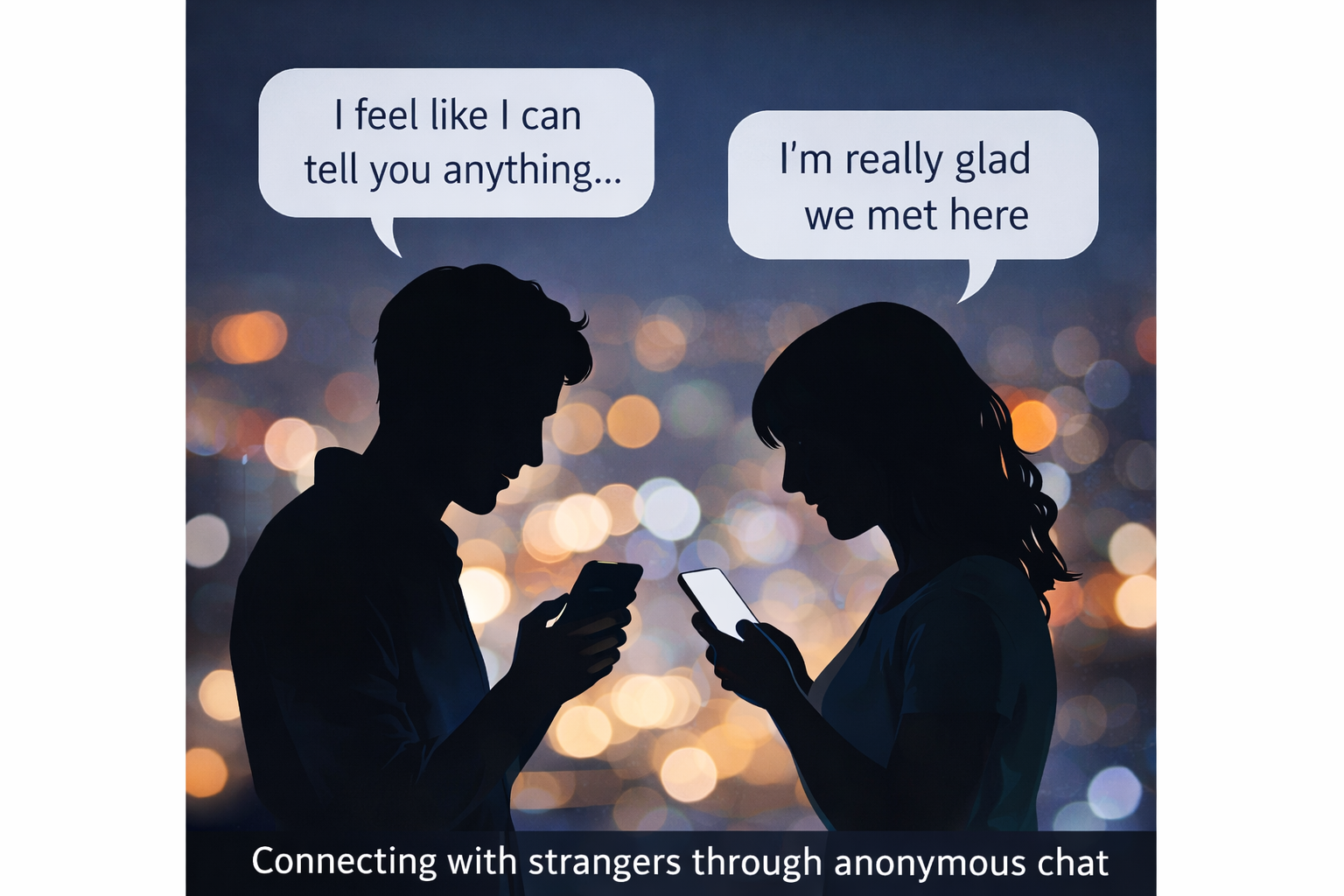
- Anonymous chat adds a further layer of safety: no social reputation at stake
- Gradual exposure through low-stakes chat can build confidence that transfers to real-world settings
Why Online Chat Reduces Social Anxiety Triggers
Social anxiety is primarily triggered by evaluation: the fear of being watched and found lacking. Online chat removes or reduces most of the cues that activate this response:
- No eye contact — one of the most anxiety-provoking elements of face-to-face interaction
- No real-time pressure — you can read, think, and write at your own pace
- No audience — the conversation is private, not observed by a group
- Anonymous option — no social reputation or pre-existing relationship to protect
- Easy exit — you can leave any conversation without the awkwardness of a physical departure
This does not mean online chat cures social anxiety. But it removes enough triggers to make conversation possible when in-person interaction feels overwhelming — and that matters.
Using Chat as a Practice Ground, Not a Hiding Place
This is the key distinction. Online chat helps with social anxiety when it is used as a stepping stone — a lower-stakes environment to practise being in conversation, getting comfortable with sharing, and discovering that most social interactions go fine. It becomes unhelpful when it replaces all in-person contact and becomes a way to avoid anxiety rather than gradually reduce it.
The goal is to practise the skills that make conversation manageable — forming thoughts, sharing honestly, handling the small discomforts — in a low-pressure environment, and let that confidence gradually carry over.
6 Techniques for Anxious Chatters
- 1. Start with interests, not open-ended chat. Matching on a topic you know well removes the pressure of having nothing to say.
- 2. Allow yourself to think before you send. That processing time is a feature, not a weakness. Use it.
- 3. Notice when a conversation goes fine. Anxious brains remember bad experiences and filter out smooth ones. Actively register when it worked.
- 4. Practise saying what you actually think. Social anxiety often leads to vague, safe answers. Gentle honesty is the skill to build.
- 5. Use the exit freely — without guilt. Knowing you can leave makes the whole conversation less threatening. The skip button is your safety net.
- 6. Gradually raise the stakes. Start with short chats. Build to longer ones. The exposure itself, at a pace you control, is what reduces anxiety over time.
How to Measure Real Progress
Progress with social anxiety is rarely dramatic. It looks like this: a conversation that would have taken 20 minutes of anxious preparation last month now takes 5. A topic you used to avoid comes up and you handle it. You notice after a chat that you were actually present in it, not just managing it. These are the real signs. The goal is not to stop feeling nervous — it is to feel nervous and keep going anyway, and to find that outcome is usually fine.
When to Seek Professional Support
Online chat is a helpful tool, but it is not therapy. If social anxiety is significantly affecting your quality of life — stopping you from maintaining relationships, working, or leaving the house — please speak to a mental health professional. Cognitive behavioural therapy (CBT) has a strong evidence base for social anxiety and is widely available. Online chat can complement that work but should not substitute for it.
💡 Take One Small Step Today
If social anxiety makes conversation feel hard, start somewhere low-stakes. Open Chatrio, pick an interest, and have one short conversation with no pressure to perform. Leave whenever you like. That one step is more than enough to start.
Frequently Asked Questions
Can online chat help with social anxiety?
Yes, when used as a practice ground rather than a replacement for all social contact. Online chat removes the main anxiety triggers — eye contact, real-time pressure, audience — making conversation possible at times when in-person interaction feels overwhelming. Over time, the practice builds confidence that can transfer to real-world settings.
Is it okay to use online chat to avoid in-person socialising?
As a temporary measure while building confidence, yes. As a permanent replacement for all offline contact, it becomes avoidance, which tends to maintain anxiety rather than reduce it. The goal is to use online chat as a stepping stone, not a destination.
Why is it easier to talk to strangers online when I have social anxiety?
Because the main sources of anxiety are removed. There is no eye contact to manage, no real-time pressure to respond perfectly, no audience watching, and no pre-existing relationship to damage. On anonymous platforms, there is also no social reputation at stake — which removes the evaluation fear at the heart of social anxiety.
How do I stop overthinking my messages?
Give yourself a short window — 60 seconds — to think, then send. The overthinking loop is sustained by the belief that the "right" message exists if you just find it. Most messages that feel imperfect land fine. Sending an imperfect message and seeing it go well is the direct antidote to overthinking.
What is the best online platform for someone with social anxiety?
Anonymous, interest-based chat is ideal. No profile means no reputation to protect, interest matching means you always have something to talk about, and the easy exit removes the trapped feeling that amplifies anxiety. Chatrio meets all of these criteria and requires no account.